They say the science on cannabis and impairment doesn't exist. Here it is.
Ella Factor
17.6.26
It started in a Sydney hospital ward
A researcher from the University of Sydney wheeled a driving simulator into Royal Prince Alfred Hospital in Sydney. Picture an arcade racing game built for science: a real car seat, steering wheel and pedals, wraparound screens showing the road, and sensors recording everything the driver did. How fast they braked. How smoothly they steered. How much the car drifted within its lane.
In this study, volunteers vaped a measured dose of cannabis. Then they drove the route while the computer logged their every move. An hour later, they drove it again. Then again after that, and again, right through the afternoon.
Why keep repeating it? Because they wanted to know whether cannabis affected driving, and how the effect changed as time passed. By testing the same people over and over through the day, they could watch the impairment arrive, reach its peak, and then slowly wear off.
And that is exactly what they saw.
Soon after vaping there was a mild effect on driving. As the hours ticked by, it faded.
Before the day was out, the volunteers were driving normally again. The impairment was real, it was modest, and it did not last!
A simulator isn’t a real road, so they took it to a freeway
Next the team needed people driving a real car at real speed in real traffic. You cannot legally do that in Australia, so they took the experiment to the Netherlands, one of the few places in the world where this kind of study is allowed.
The car had a second steering wheel and pedals on the passenger side, so a driving instructor could take over instantly. Volunteers vaped just under 14 milligrams of THC – an amount that’s within the range a doctor might prescribe – then drove 100 kilometres on a live motorway at highway speed while instruments measured how steadily they held their lane.
Each person did the driving test twice. Once in the first hour after vaping, and once again four to five hours later. In that first hour there was a mild wobble, the kind of small effect you would see in a driver with a blood alcohol reading somewhere between 0.02 and 0.05, at or below the legal alcohol limit. By the second test, four to five hours on, it had gone.
Something else stood out. Unlike drivers impaired by alcohol, these drivers drove carefully. They eased off the speed and left bigger gaps to the car in front, as if they sensed they needed a wider margin and gave themselves one. The study was published in 2020 in JAMA, one of the most respected medical journals in the world.
Then the same team put every study together
By 2021, the same team of Sydney researchers, now with Danielle McCartney leading, stepped back to look at the whole field. Researchers around the world had run dozens of studies like theirs. McCartney’s team gathered every study that met a strict quality bar, pooled the raw results, and modelled how long it took for driving skills to recover after people consumed cannabis.
The pattern seen in the earlier research held.
Here the work crossed from interesting findings into settled science: the impairment window has a clear, predictable shape.

It comes down to two things, the dose and how you take it.
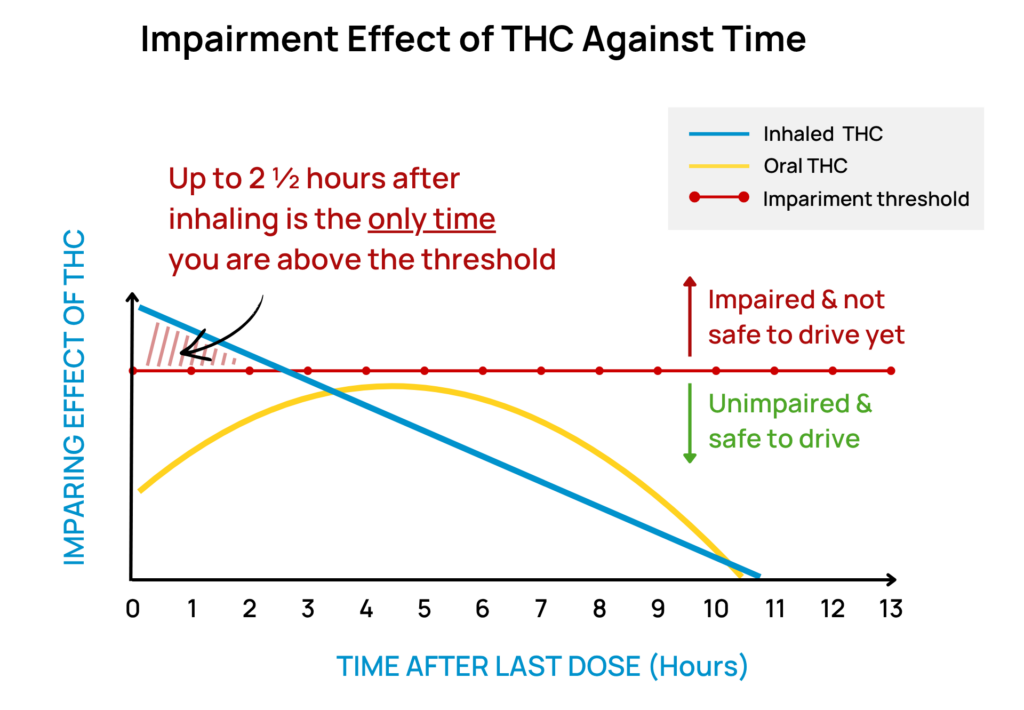
Inhaled cannabis (smoked or vaped) acts fast and fades fast. Cannabis you eat in an oil, capsule or gummy (edibles) absorbs slowly and lasts longer. With both methods, as you’d expect, a bigger dose takes longer to clear.
Put all this together: after vaping or smoking a 20mg dose, most driving skills return to normal within three to five hours. A smaller vaped dose can clear in a few hours.
After a 20mg dose of edibles, driving skills return within about eight hours. A large oral dose can take most of a working day.
Either way, it clears within hours, and it clears on a predictable timeline.
Then they tested actual patients
Almost everyone in those early studies used cannabis only occasionally. Patients differ from other cannabis consumers: they tend to be older, and often use the same strong product every single day.
So researchers at Swinburne University tested actual patients on their own prescribed medicine. The results sat in a surprising range: from slightly impaired at one end to unchanged, or even slightly improved, at the other, with a minority showing no impairment at all. Even soon after a dose, many patients retain most driving skills. So the people who use their medication most often, turn out to be the people with the least impairment.
What about population level risk? That’s been studied too!
Step back from the lab and look at the whole road, every driver, every crash, across years of pooled data, and the picture holds.
Among all the things that can affect driving, cannabis sits low on the risk register.
Evidence reviews put a cannabis-positive driver at around 1.1 to 1.4 times the crash risk of a sober one. This is in the same ballpark as a blood alcohol reading at or below the legal limit, and is less impairment than drivers experience with common prescription medicines like opioids and benzodiazepines.
Across the whole population, the presence of THC barely shifts crash risk, and cannabis contributes only a small share of total crashes. The real risk sits with one small group: people driving soon after a heavy dose – exactly what a good recent-use test would catch.

We already know what happens to the road stats when patients are allowed to use their medicine and drive, because plenty of other places have already done it. In US states that legalised medical cannabis researchers have tracked road deaths over several years. Those states saw fewer fatal crashes, for both men and women. Part of the reason traces to patients shifting off riskier medicines like opioids. Letting sick people use their medicine left those roads safer.
The US is just one example. Many countries run medicinal cannabis schemes, among them the UK, Germany, Ireland, Norway and New Zealand, and they let prescribed patients drive whenever they remain unimpaired. Every one of them treats a trace of THC more sensibly than our law does. If protecting patients on the road carried the danger the critics claim, those countries would show it first. Years on, their roads look fine.
That’s the evidence. It’s a decade deep, it’s peer-reviewed, and it’s clear.
So can we test impairment?
Let’s start with the obvious question. If science can predict impairment, could police simply measure impairment directly at the roadside, instead of testing saliva for a trace? The practical answer is that there is no quick, objective roadside test for cannabis impairment. Roadside impairment assessments, where an officer watches someone balance and turn, are slow, subjective, and easy to argue about in court. They do not scale to the side of a highway at two in the morning.
That leaves us with the real question.
Can a saliva test be made to sort people fairly, even though it cannot read impairment directly?
It can, once you set a sensible threshold grounded in the science and stop treating every trace as a crime.
So what does the science on saliva testing tell us?
There’s two ways to test for THC in saliva, and a lot of the confusion in this debate comes from mixing them up. One cannot measure the concentration, it just tests if there is any presence at all, even a trace amount is enough to register a positive test.
The other method is measuring the actual amount of THC in the saliva: the ‘concentration number’. These tests can be set to different cut off levels, known as ‘per se threshold tests’. Under the current NSW zero-tolerance law any presence above zero is an offence. But presence tells us nothing about impairment, it can’t tell how long ago the patient consumed.
Multiple clinical studies have been conducted using the higher quality tests that measure concentration. These studies have also found a clear time based pattern. Researchers asked frequent and occasional cannabis users to smoke under controlled conditions, then measured the THC in their saliva again and again over the next thirty hours.
The below chart illustrates the typical timeline for THC concentration, as reported by Newmeyer. It spikes quickly after inhalation, often reaching several hundred nanograms per millilitre. Then it falls off a cliff, both for occasional and frequent users. Within hours it’s a small fraction of that, and by the next day, in occasional users, it drops to zero.

Next look at the blue line, which represents the average frequent user in the study. Their line does not drop to zero by the next day. Given patients are often prescribed daily use, this chart clearly shows that if the threshold is set too low, as per the red dotted line illustrating a cut off of below 10ng/ml, the average frequent user would test positive at 20 hours.
But the chart doesn’t show the outliers, just the average. So at the threshold in this chart, the great majority of regular users would still register a “positive” reading, long after all effects have cleared. The low threshold cut off sets the bar so close to zero that the trace trips it.
So look closely at what a zero tolerance regime actually does.
It checks for only one thing: whether you used THC at all, anytime in the past days or more.
A patient who dosed last night and drives perfectly safely the next morning tests positive just the same as someone who used twenty minutes ago. The law checks for trace residue and convicts the sober.
Here’s how you build a test that works
Science has handed us the pieces of evidence that fit together, to design a system that works, that allows unimpaired patients to drive.
The studies measured how THC affects driving, and how that differs between regular and occasional users. They found the impairment real but modest, and that regular users, with their built-up tolerance, feel it least of all.
The studies measured how long that impairment lasts. They found a predictable clock: a few hours after vaping, up to around eight hours after edibles.
The studies measured what happens in saliva over that same stretch: a high number right after use, falling to a faint trace as the hours pass.
So we have our answer.
Wait the time the science says to wait, and for most people two things come true at once: you are safe to drive, and your saliva reading has fallen to a faint trace.
Put the two together and you have a system that works, once we design and run it properly.
The per se threshold is the key decision
The roadside test threshold needs to sit high enough to pass a patient who has waited the right time, including a daily user who carries a high personal baseline of THC residue, while still catching anyone who used too recently. Get the level right and the test stops chasing yesterday’s medicine and starts measuring what matters: recent use.
Image Credit:
Images produced by Unharm based on data from studies referenced below.
References:
[1] Arkell, T. R., McCartney, D., & McGregor, I. S. (2021). Medical cannabis and driving. Australian Journal of General Practice, 50(6), 357–362. https://doi.org/10.31128/AJGP-02-21-5840
[2] Arkell, T. R., Vinckenbosch, F., Kevin, R. C., Theunissen, E. L., McGregor, I. S., & Ramaekers, J. G. (2020). Effect of cannabidiol and Δ9-tetrahydrocannabinol on driving performance: A randomized clinical trial. JAMA, 324(21), 2177–2186. https://doi.org/10.1001/jama.2020.21218
[3] Manning, B., Arkell, T. R., Hayley, A. C., & Downey, L. A. (2024). A semi-naturalistic open-label study examining the effect of prescribed medical cannabis use on simulated driving performance. Journal of Psychopharmacology, 38(3), 247–257. https://doi.org/10.1177/02698811241229524
[4] McCartney, D., Arkell, T. R., Irwin, C., & McGregor, I. S. (2021). Determining the magnitude and duration of acute Δ9-tetrahydrocannabinol (Δ9-THC)-induced driving and cognitive impairment: A systematic and meta-analytic review. Neuroscience & Biobehavioral Reviews, 126, 175–193. https://doi.org/10.1016/j.neubiorev.2021.01.003
[5] Newmeyer, M. N., Desrosiers, N. A., Lee, D., Mendu, D. R., Barnes, A. J., Gorelick, D. A., & Huestis, M. A. (2014). Cannabinoid disposition in oral fluid after controlled cannabis smoking in frequent and occasional smokers. Drug Testing and Analysis, 6(10), 1002–1010. https://doi.org/10.1002/dta.1632
Tell your NSW MP, let patients drive!
MPs need to hear from people who support fair reform. Tell them: patients deserve support, not court. Just enter your name and address, hit send, and it goes straight to your local MP plus key ministers.
Email your MP with this tool, it only takes 30 seconds!

Chip in to power our ad blitz
Your donation will go directly to getting our campaign ads in front of thousands of people across Facebook and Instagram. The more people we reach, the more pressure MPs will feel to fix these unjust laws.
